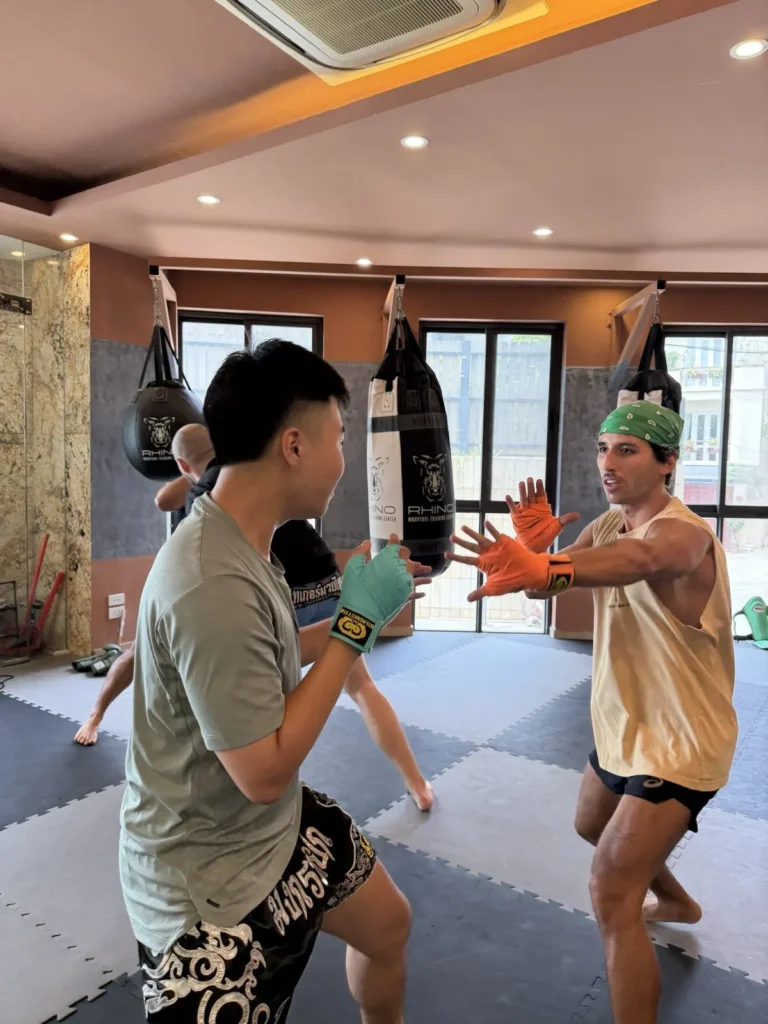
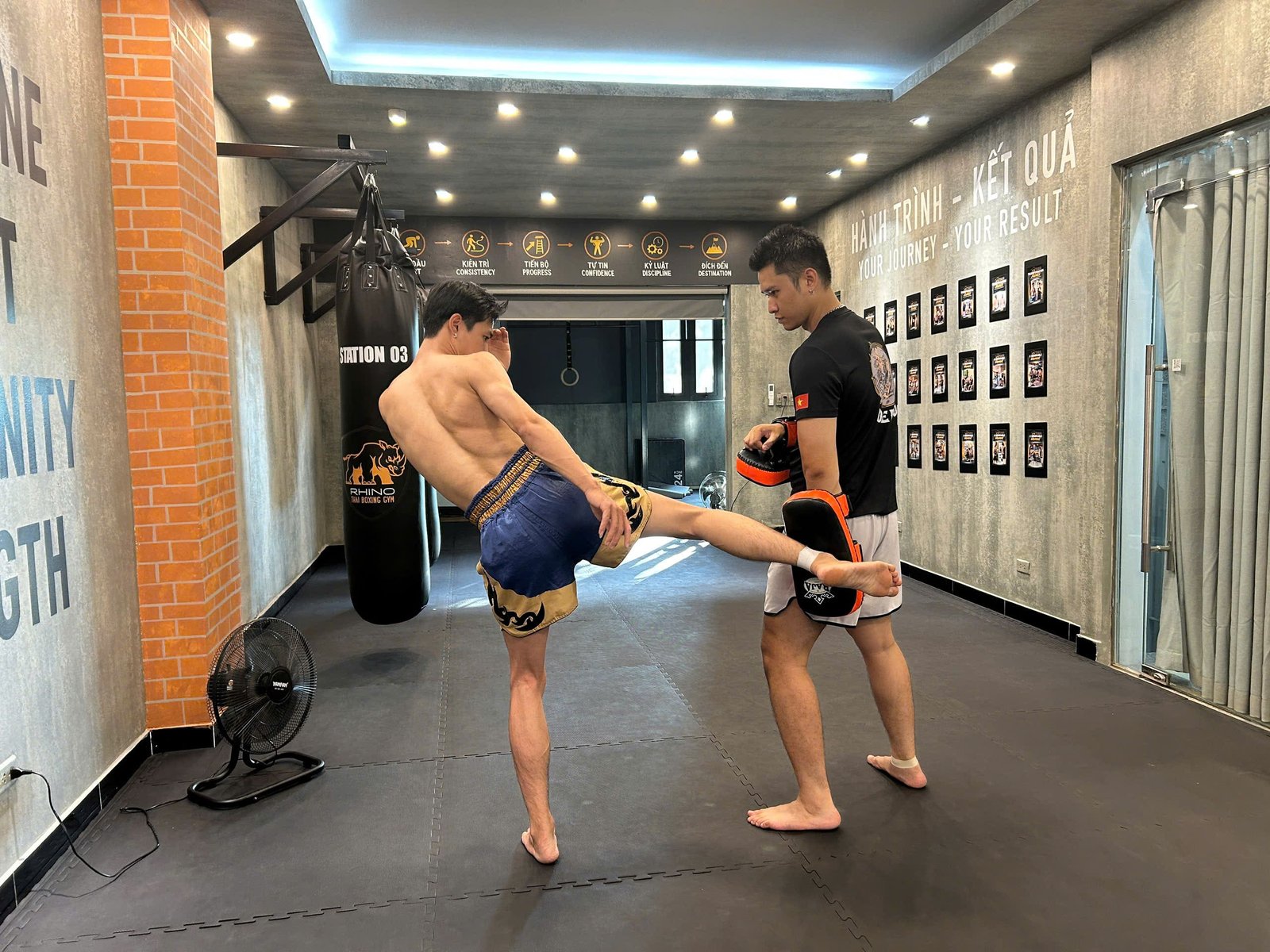
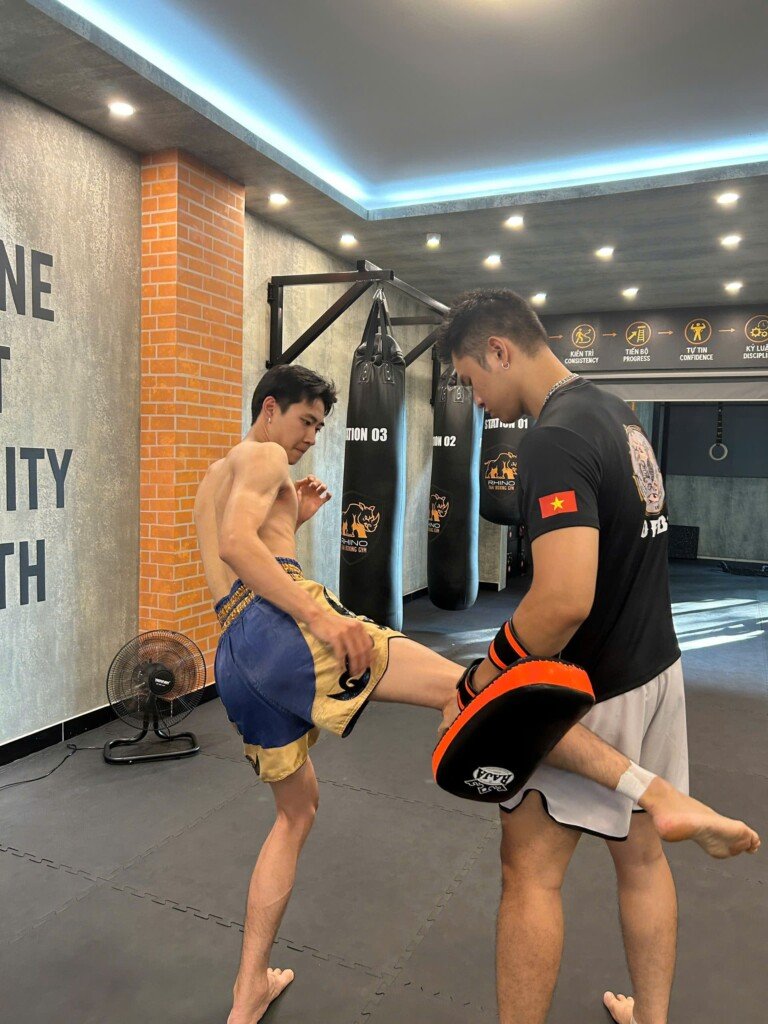
How to throw a low kick, in one sentence: turn the heel of your standing foot, let the hip open, land on the shin rather than the foot, and recover to your guard before you think about the next one. Power comes from the turn, not from swinging the leg harder.
This is the five-step sequence, the five errors coaches correct most, and one safety cue that matters more than any of them. Read it once before your next session and the pad work will make more sense. The sequence is an editorial proposal drawn from standard practice, not RHINO’s official curriculum — a coach adjusts it to your hips, your ankles and whatever you did before you walked in.
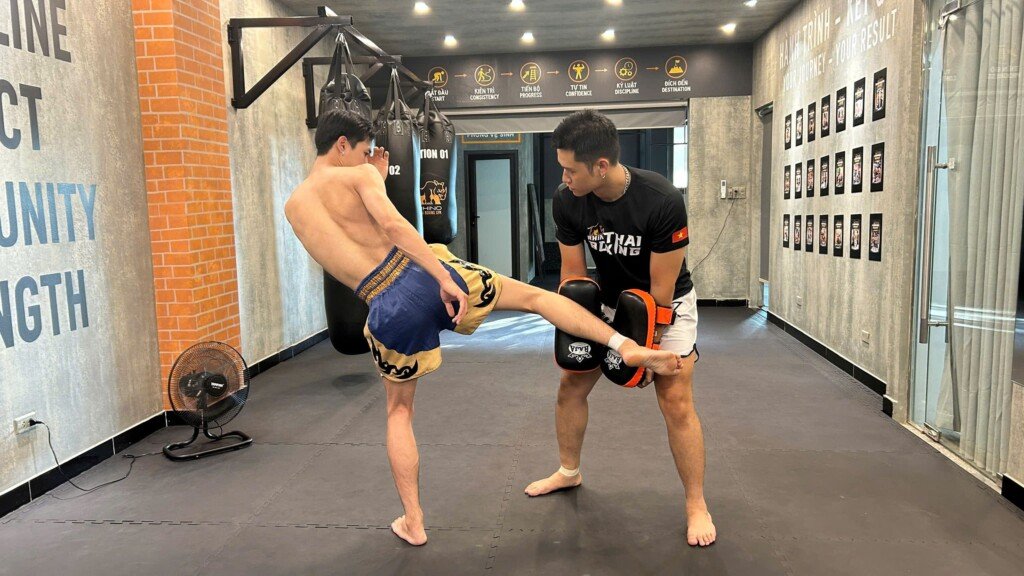
How to throw a low kick in 5 steps
Practise it slowly first. Every error further down the page comes from adding speed before the order of movement is settled, so treat how to throw a low kick as a sequence to rehearse rather than a thing to attempt hard.
- Step the lead foot slightly offline. Move it off the straight line between you and the target, so the hip has somewhere to rotate into.
- Turn the heel of the standing foot outward. The heel pivots and the knee stays soft. This is the step that opens everything else; skip it and the hip stays locked.
- Let the hip carry the leg. Hip and kicking leg travel together as one piece. The leg does not swing on its own.
- Land on the shin, about a third of the way up from the ankle. Foot relaxed, toes not clenched.
- Recover along the same path. Back to your guard before the next kick, not after it.

Land on the shin: the one safety cue
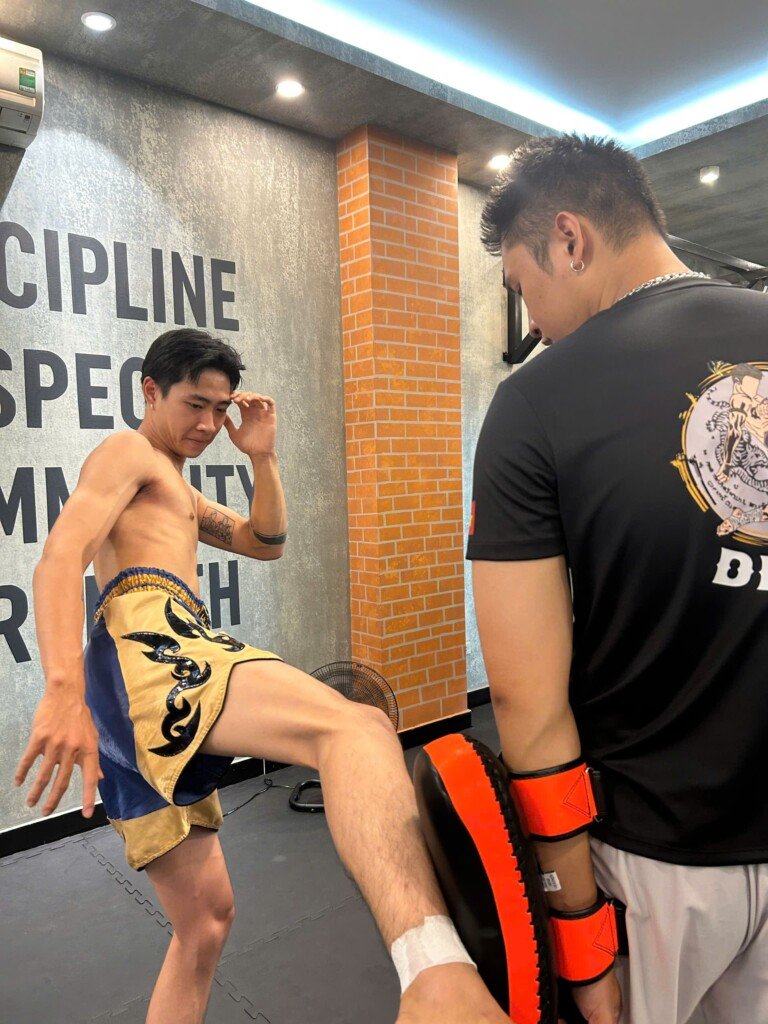
If you remember nothing else from this article, remember the contact point. The shin lands, never the instep or the toes. The shin is one long bone built to take load. The foot is a cluster of small bones and joints, and kicking a firm target with it is the quickest route to a few weeks off.
The cue that goes with it: soft pads, slow reps, and let a coach watch the path before you add force. Shins toughen through consistent training over months — not by kicking hard objects on purpose. If you have a history of knee, ankle or shin problems, say so before the session starts. Our article on injuries beginners actually get covers what turns up in a first year, and it is not a substitute for a doctor.
Muay thai low kick technique: where the power comes from
Muay thai low kick technique treats the leg like a bat rather than a needle, and that is the single idea that separates it from a snapping kick. The shin sweeps through the target across a length of bone, instead of stabbing at one small point with the foot, and that changes where the force has to come from: the standing heel and the hip, with the torso following.
IFMA describes Muaythai technique in terms of timing, accuracy and effective execution. In a low kick all three happen inside about a second, which is why coaches break the movement into pieces and rebuild it slowly. From the outside they can see which piece arrives late. From the inside, you cannot — which is most of what a coach adds to muay thai low kick technique.
Low kick, muay thai leg kick or calf kick? The words people use
English-speaking gyms use several names for overlapping things, and the search results mix them freely. Worth untangling before you ask a coach for one:
| Term | What people usually mean |
|---|---|
| Low kick | Any round kick below the belt, in Muay Thai and kickboxing alike |
| Muay thai leg kick | The most common English name for it in a gym setting |
| Leg kick | The same kick, named after the target rather than the height |
| Calf kick | A round kick aimed lower, at the outside of the calf — popularised by MMA broadcasts |
| Mid kick | The same movement at body height, a different balance problem |
They are variations of one motion, not four techniques, and how to throw a low kick is the same answer for all of them. Ask for a muay thai leg kick or a low kick and you will be shown the same movement. Learn the turn and the contact point, and the target becomes a detail you and your coach choose. That is also why a beginner class starts at leg height: get it wrong down low and you lose a little balance, get it wrong up high and you lose a lot.
What transfers if you did boxing, taekwondo or K-1
Most people walking into a Tay Ho gym have trained something before, and each background brings its own habit:
- From boxing: your hands and footwork are ahead of the room, but the hips are used to staying square. The turn is the thing to unlearn.
- From taekwondo or karate: you already kick, and you probably snap from the knee and land with the instep. The sweep and the shin contact are the change, and a muay thai leg kick will feel heavier and slower at first.
- From K-1 or kickboxing: the muay thai leg kick is already familiar. Expect more attention on the clinch and on knees, which our Muay Thai clinch article covers.
- From nothing at all: honestly the easiest starting point, because there is no habit to overwrite.
One equipment note for anyone watching the sport and wondering: in IFMA competition a shin guard is mandatory equipment, alongside the head guard and elbow guards, and gloves are fitted under supervision. What you see on a broadcast is not what an amateur ring requires.
5 errors a coach corrects most often
| Error | What you notice yourself | The usual fix |
|---|---|---|
| Standing heel never turns | Hip feels locked, the kick stops short | Drill the pivot alone, without kicking |
| Contact on the instep or toes | Sore foot or ankle after the session | Less force, softer pad, re-check the distance |
| Standing too close or too far | Reaching with the leg, or the shin folding mid-path | Reset the distance before every rep |
| Leaning back to kick higher | A stagger step after the kick to stay upright | Lower the target, keep your eyes on the pad |
| No recovery to guard | Hands drop, torso opens, you gas quickly | Short rounds, and count the recovery as part of the rep |
The first four are technical and the fifth is a habit, which makes it the stubborn one. Most people asking how to throw a low kick are really asking about one of these five. The kick can look good and still leave you standing in the wrong shape afterwards. A coach spots that immediately; a mirror at home almost never does.
What the research says about supplementary training
A controlled trial published in 2026 put 39 highly trained male Muay Thai athletes aged 15 to 25 through six weeks of tire-squat and explosive-kicking work on top of their normal training. Compared with the control group, they improved stimulus-to-contact time by 0.05 seconds, reduced their drop-off across repeated kicks by 3.2%, and became more consistent between kicks by 1.8 percentage points.
Three things deserve equal billing with those numbers:
- Kick accuracy did not hold up as statistically significant after adjustment, and neither did dynamic balance or side-to-side asymmetry.
- The programme combined two kinds of training, so the authors say plainly that the contribution of each cannot be separated.
- These were highly trained athletes. Nothing here promises the same to someone training twice a week.
The honest takeaway is narrow: supplementary strength work supports timing and consistency in muay thai low kick technique. It does not replace fixing the path of the kick, and it is not where a beginner should start.
Beginners throwing a low kick are usually in a hurry to hear the pad. I slow them down, get the standing heel turning properly first, and only then talk about power. Once the shin lands in the right place, the sound arrives on its own.
Coach Uni, Main Coach at RHINO
Want a coach to watch your kick?
Tell RHINO your experience and what you want from training. Sessions run as private 1-1, private 1-2 for two people who book together, or groups capped at six.
Private session or group class for learning to kick?
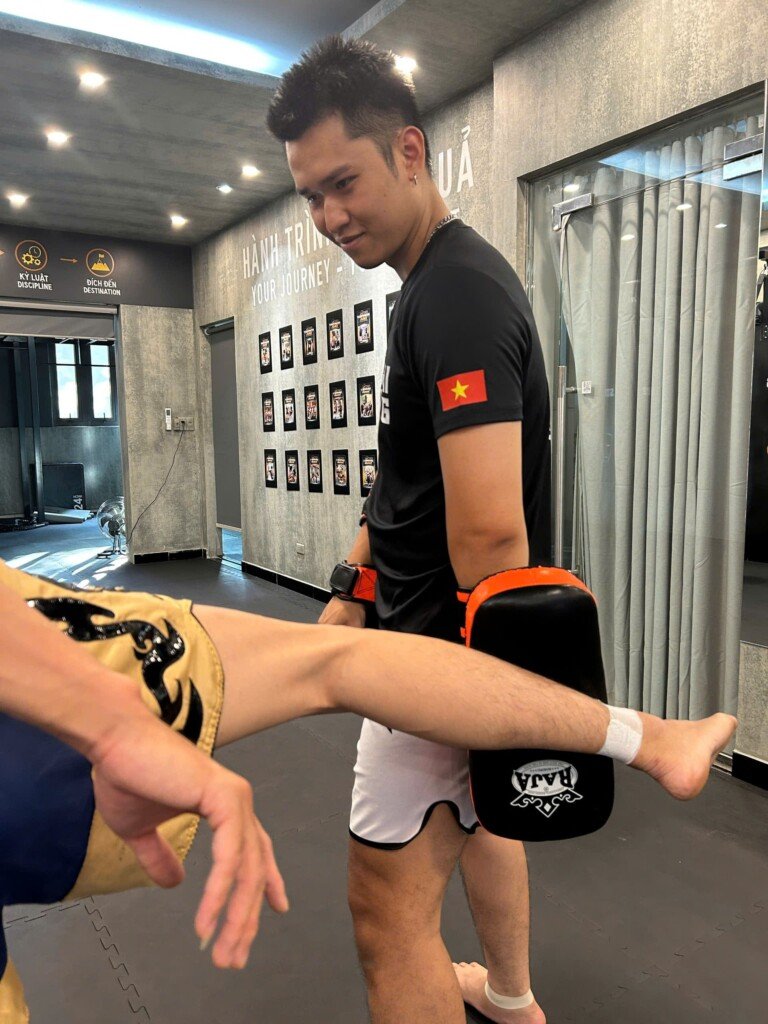
For a movement with this many details, a private session lets a coach hold the pad themselves and spend the hour on one error. That is the fastest way to learn how to throw a low kick without building a habit you later have to undo. They can change the distance, change the angle of the pad, and stop the moment the path starts to drift. A 1-2 session — two people who book together and alternate — keeps most of that feedback time per person.
A group class capped at six still includes technique and pad work; the difference is that the coach’s attention is divided. Neither is the right answer for everyone: it depends on your schedule, your goal, and how much detail you want corrected. The private training guide sets the formats side by side, and the two locations article covers both gyms if you are choosing by commute.
FAQ
Can a complete beginner learn how to throw a low kick in the first class?
Yes. Many first sessions cover how to throw a low kick on a soft pad at low force. The first pass usually covers only the standing foot, the direction of the hip and the contact point. Speed and power come later, once the path is clean.
Is it normal for my shins to hurt after kicking?
Mild soreness after an early session is common. Sharp pain or swelling is not — tell a coach and get it looked at. Shins adapt through regular training, not by being deliberately battered against hard objects.
Can I practise a muay thai leg kick at home?
You can rehearse the sequence slowly in front of a mirror to fix the order: pivot, hip, contact, recover. What you cannot check alone is which part of your shin lands and when, because that needs an outside eye. Do not kick walls, posts or an improperly mounted bag.
Is the low kick the strongest kick in Muay Thai?
This article does not rank kicks, because force depends on the person and the situation. What is true is that a muay thai leg kick is easier to stay balanced on than a head kick, which is why it usually comes first.
How long before it feels natural?
There is no shared timeline. Most people get the pivot and the distance under control long before the kick feels effortless, and a coach watching it once a week shortens that considerably.
Learning how to throw a low kick comes down to four things in order: turn the heel, open the hip, land on the shin, recover to your guard. If you would like someone to watch those four and tell you where the power is leaking, call 091 2000 979 or send a question through the contact page. RHINO has two gyms in Tay Ho: Branch 1 at 87 Alley 50 Dang Thai Mai, Quang An, Tay Ho, Hanoi, and Branch 2 at 23 Alley 52 To Ngoc Van, Tay Ho, Ha Noi.