
The most useful gym tips for beginners come down to three numbers: pick a weight you can lift with good form for 8 to 12 reps, train 2 to 3 days a week, and add weight only in small steps. Those figures come from the American College of Sports Medicine (ACSM) guidance for people with no lifting experience. In your first month, a light weight lifted well matters far more than the number on the plate.
This guide covers eight rules for your first four weeks, how often a beginner should train, what to bring to your first session, and the common mistakes that set new lifters back. It is written for recreational trainees. If you have a medical condition or an old injury, check with a doctor before you start.
Gym Tips for Beginners: 8 Rules for Your First Month
Most of the figures below come from the ACSM position stand on resistance training progression, which sets out recommendations for novices, meaning people who have never lifted or have not trained for several years. Here are the numbers worth knowing before you pick up a dumbbell.
| Question | Recommendation for beginners | Source |
|---|---|---|
| How many reps per set? | A weight you can lift 8 to 12 times | ACSM |
| How many sessions a week? | 2 to 3 | ACSM |
| When do I add weight? | When you can do 1 or 2 reps beyond your target, add 2–10% | ACSM |
| Which exercises first? | Large muscle groups and multi-joint lifts | ACSM |
| How many strength days a week? | At least 2, covering all major muscle groups | NHS |

1. Warm Up Before You Touch a Weight
Muscles and joints work better once they are warm. A few minutes of shoulder circles, hip rotations, light stretching and bodyweight movements also tell you how your body feels today. If you feel stiffer than usual, spend longer on the warm-up rather than rushing to the rack.
2. Choose a Weight You Can Lift 8 to 12 Times With Good Form
ACSM recommends that beginners use a load they can lift for roughly 8 to 12 repetitions per set. If you are arching your back, twisting or jerking the weight by rep five, it is too heavy. If twelve reps still feel easy, go up a little next session.
3. Learn the Technique Before You Load It
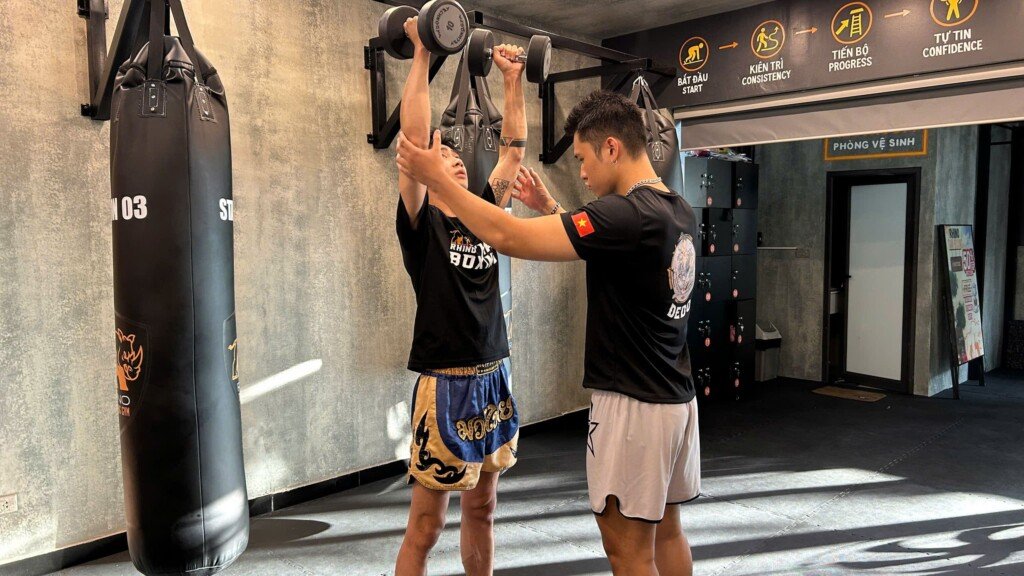
Squats, deadlifts and overhead presses all have details a beginner cannot easily see in themselves: whether the back stays straight, whether the knees cave in, whether the bar travels in a straight line. A mirror helps a little, but someone watching from the side spots errors much faster. That is why a few early sessions with a coach are usually worth more than any weight you manage to lift.
4. Add Weight in Small Steps
Once you can do one or two reps more than your target with clean form, ACSM suggests increasing the load by about 2–10%. On a 10 kg dumbbell, that is only 0.2 to 1 kg. It can feel slow, but small jumps give your muscles, tendons and joints time to adapt.
5. Train 2 to 3 Days a Week and Keep Rest Days
ACSM recommends 2 to 3 resistance sessions a week for beginners. The NHS physical activity guidelines also advise strength work on at least 2 days a week, covering legs, hips, back, abdomen, chest, shoulders and arms. Rest days are not lazy days. They are when your body recovers so the next session goes better.

6. Do Big Lifts First, Small Lifts Last
ACSM advises putting large, multi-joint exercises such as squats, deadlifts and presses before single-joint moves such as curls or triceps extensions. The big lifts need the most strength and concentration, so do them while you are fresh. Leaving them until the end, when you are already tired, is when technique tends to fall apart.
7. Know the Difference Between Soreness and Pain
Many beginners feel stiff and sore for a day or two after their first sessions, especially in muscles they rarely use. Sharp pain in a joint, pain that travels down an arm or leg, or pain that gets worse during a set is something else. If you notice any of those, stop the exercise and tell your coach straight away rather than finishing the set.
8. Bring Water and Eat Properly Around Training
You will sweat more than you expect in a Hanoi summer, so bring your own bottle and drink between sets. After training, a normal meal with rice or noodles, a protein and vegetables is enough for most beginners. Our guide on what to eat after gym at night has practical options around Tay Ho.
How Often Should a Beginner Go to the Gym?
The short answer to how often should a beginner go to the gym is 2 to 3 strength sessions a week. The NHS also recommends at least 150 minutes of moderate activity a week for adults, and that target sits on top of strength training rather than replacing it. Walking, cycling or a Muay Thai class on your non-lifting days all count.
Neither guideline sets a fixed length for each session. What matters is that you finish your main lifts with good technique, not how long you stay in the building. If you also run, the guide to strength training for runners in Hanoi shows how to fit both into one week.

Beginners often want to know how many kilos they lifted today. I only look at whether the back is straight and the knees point the right way. Once the technique is solid, the weight can go up any time. If it is wrong from the start, it takes a long time to fix.
Debo, RHINO Main Coach, Boxing and Strength & Conditioning (translated from Vietnamese)
Common Beginner Gym Mistakes and Simple Fixes
Each of the rules above has an opposite habit that new lifters fall into, often out of enthusiasm rather than carelessness. This table matches those mistakes with the fix the guidance points to.
| Mistake | Why it causes problems | Simple fix |
|---|---|---|
| Starting too heavy | Form breaks down before the set ends | Pick a weight you can lift 8 to 12 times cleanly |
| Adding weight every session | Joints and tendons have no time to adapt | Add 2–10% only after you beat your target by 1 or 2 reps |
| Training every day | No recovery between strength sessions | 2 to 3 lifting days, with rest or light activity in between |
| Saving squats and deadlifts for last | Big lifts done tired, when form slips | Big, multi-joint lifts first |
| Skipping the warm-up | Cold muscles, and you miss early warning signs | A few minutes of mobility before every session |
| Pushing through sharp pain | A small problem can become an injury | Stop and tell the coach |
Want a coach beside you for your first gym sessions?
RHINO’s Gym programme runs as private sessions with a coach or as group classes. The coach picks exercises and weights for your current fitness and builds them up week by week.
What to Bring to the Gym as a Beginner
You do not need to buy much to get started. When people ask what to bring to the gym as a beginner, the honest list is short: comfortable clothes, a water bottle and a towel. Lifting gloves, a belt and supplements can all wait until you train regularly and know what you actually need.
| Bring | Can wait | Note |
|---|---|---|
| Stretchy, breathable clothes | Lifting gloves | Very loose clothing can catch on equipment |
| Your own water bottle | Lifting belt | A belt does not replace good technique |
| A sweat towel | Supplements | Ask a doctor before starting any |
| A list of old injuries | Your own written programme | Tell the coach in your first session |
The most important thing to prepare does not go in your bag. Tell your coach about any old injury or health condition, even one you think healed long ago, so they know which exercises to change or lighten.
When to Check With a Doctor First
If you have heart disease, high blood pressure, diabetes, are pregnant, or have an old back, knee or shoulder injury, ask a doctor before you start lifting. The NHS also advises seeing your GP first if you have not exercised for some time or have health concerns. A coach can swap exercises and reduce the load, but cannot replace a medical check.
During any session, stop and tell your coach immediately if you feel dizzy, get chest pain or become unusually short of breath. The guide to Muay Thai injuries for beginners explains which kinds of pain you should never train through.
Frequently Asked Questions
Should a beginner go to the gym every day?
Not for strength training. The recommendation for beginners is 2 to 3 lifting sessions a week, with rest days in between so your muscles can recover. On the other days you can still walk, cycle or stretch lightly.
Do I need a personal trainer as a beginner?
It is not required, but a few early sessions with a coach help you learn the main lifts properly and choose sensible weights. Bad habits learned in week one take far longer to undo. Once the basics are solid, you can train on your own and ask a coach to check your form now and then.
Should I train if I am still sore?
Mild stiffness is fine for light activity or for training a different muscle group. If soreness makes it hard to move, or the pain is in a joint rather than a muscle, rest and ask your coach or a doctor. Do not add weight while you are still recovering.
Will lifting make women bulky?
The loads recommended for beginners do not build muscle size quickly, and changes in body shape depend heavily on diet. Our article on what Muay Thai does for your body describes a study of untrained women whose lean mass did not change significantly over 13 weeks of Muay Thai.
The gym tips for beginners that matter most fit in one line: lift light enough to do 8 to 12 clean reps, train 2 to 3 days a week, and add weight in small steps. To ask about the gym area or private sessions with a coach, call 091 2000 979 or use the contact page. RHINO has two locations, at Dang Thai Mai and To Ngoc Van, both in Tay Ho.