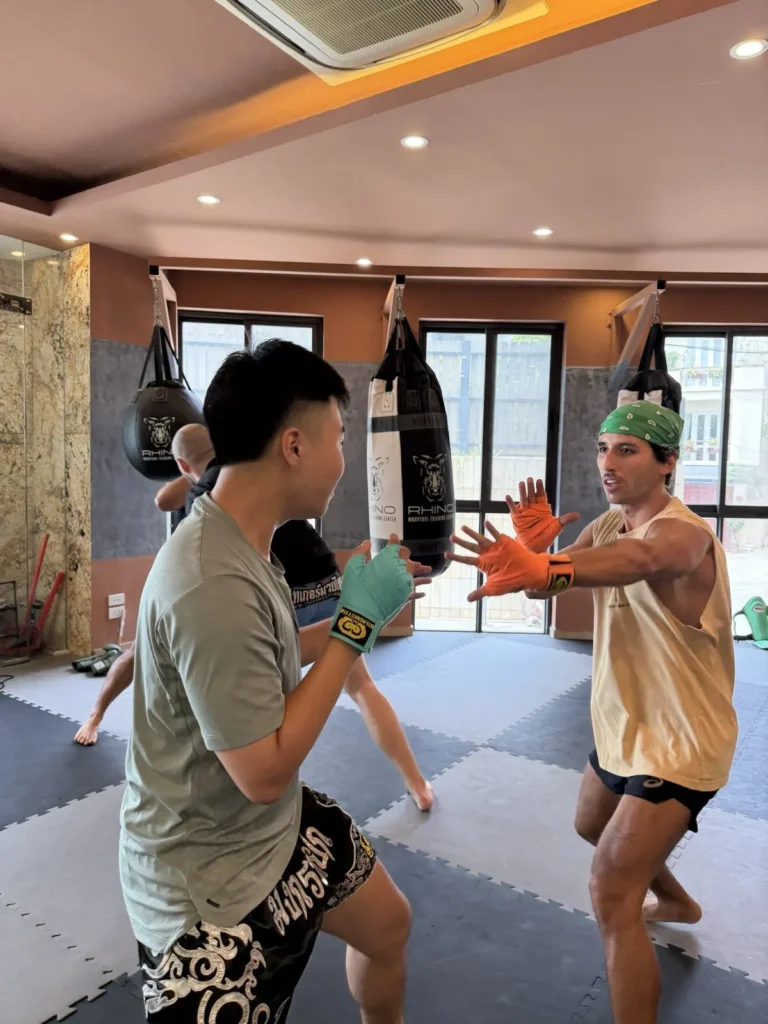

Heavy bag training benefits come down to three things the bag does better than anything else on the gym floor: it absorbs real force, it lets you work uninterrupted rounds, and it shows you honestly how much technique you have left at minute three. What the bag never does is move, change angle, or tell you that your elbow is drifting.
That is why this article compares all three tools you will meet in a session — the bag, the pads a coach holds, and shadow boxing — instead of listing what the bag is good for and stopping there. Pad work vs bag work is the comparison most people are really asking about, and there is a measured answer to it further down. The way the goals are split below is an editorial proposal, not RHINO’s official curriculum. A coach arranges the real session around your fitness, your history and what you are currently getting wrong.
Heavy bag training benefits: what the bag actually builds
Heavy bag training starts from one physical fact: the bag takes load, which makes it the only one of the three tools where you can put a complete strike into something with mass. Three things come out of that. Your shins and knuckles get used to contact in small, repeated doses. Your body learns to stay balanced after impact rather than before it. And you find out where in a round your form starts to slide, which is information no mirror will give you.
Round length is what makes that last point useful. The first punch of a round is always tidy. The fifteenth tells you what your conditioning is really like, and heavy bag training is the part of a session built to run long enough to expose it. That is the honest core of the heavy bag training benefits list — force, rhythm and endurance, measured over time rather than in single reps.
The bag is also silent, and that cuts the other way. It does not step back, it does not change the angle, and it will not correct you. A technically wrong strike still makes a loud, satisfying noise, so working the bag alone is an efficient way to rehearse a mistake. This is the single thing coaches repeat most often to people who train at home.
Heavy bag vs punching bag vs Thai bag: the words people mix up
English gives the same object four names, and they are not interchangeable. Worth two minutes of your time, because the equipment in the room decides what heavy bag training you can actually do in it.
- Punching bag is the generic term. It covers everything that hangs and gets hit, which is why it is the least useful word of the four.
- Heavy bag is the hanging cylinder filled to a weight that resists you. This is the one this article is about.
- Thai bag, sometimes called a banana bag, is longer — often floor-length. The extra length is not decoration: it gives you a target for low kicks, which a short bag simply does not have.
- Speed bag trains timing and shoulder endurance. It holds almost no mass, so it is not a substitute for the heavy bag, and nobody conditions a shin on one.
If you train Muay Thai and the room only has short boxing bags, your kicks have nowhere to land below the knee. Our guide to throwing a low kick covers why that height matters and what a coach watches for.

Pad work vs bag work: what a 2020 study measured
A 2020 study in the Journal of Strength and Conditioning Research put 14 male elite amateur boxers through the same three-round, three-minute protocol twice — once on a punch bag and once on a pad routine held by a coach. It did not find a winner. It found that the two demand different things from you.
| Measure | Pad routine | Bag routine |
|---|---|---|
| Average heart rate | 160 b/min | 150 b/min |
| Average oxygen consumption | 38.00 ml/kg/min | 34.40 ml/kg/min |
| Blood lactate | 2.7 mmol/L | 2.3 mmol/L |
| Total and side-to-side PlayerLoad | lower | higher |
| Rating of perceived exertion | no significant difference between the two |
Read down the columns and the pattern is clean. The pad routine was more physiologically demanding; the bag routine was more mechanically demanding. Yet the boxers rated the two rounds as feeling about equally hard, which is the finding worth carrying into your own session: how hard something feels is a poor guide to what it is loading.
Two limits belong next to those numbers. This was 14 highly trained men running a fixed protocol, so it does not describe an average class, and the effect in a beginner has not been measured. It was also a boxing study, while a Muay Thai round adds kicks, elbows and clinch — the IFMA, the sport’s international federation, groups pad work, bag work and circuit work together as training tools of the same sport. The clinch is a good example of a skill neither the bag nor the pads teaches on its own.
The practical read on pad work vs bag work: if you want your heart and lungs to do more work today, pads with a coach is the reasonable choice. If you want your body to absorb more impact load, the bag does that. Which is exactly why one does not replace the other.

Shadow boxing vs heavy bag: where should a beginner start?
Shadow boxing vs heavy bag is usually the wrong way round to ask it, because for a new movement the answer is almost always shadow boxing first. A mistake there costs nothing. Once the path of the strike is tidy, the bag adds impact. Pads come after that, when there is a reason to have someone reacting to you. The order is not a rule — it moves depending on what you are trying to fix this week.
| Tool | What it does best | What it cannot do |
|---|---|---|
| Shadow boxing | Cleans up the path of a strike, warms you up, no impact at all | No contact feedback, no real sense of distance |
| Heavy bag | Absorbs real force, builds rhythm and endurance across rounds | Does not move, does not correct you |
| Pads with a coach | Immediate feedback, changing distance and angle, stops the round to fix things | Needs a coach with free hands for the whole round |
Once you have some training behind you, all three can sit in one session: shadow boxing in the warm-up, pads in the middle while you are still sharp enough to absorb a correction, and the bag at the end to push conditioning. Shadow boxing vs heavy bag is not a choice you make once and keep — it is a decision about what the next twenty minutes is for.
Hitting the heavy bag without hurting your hands and wrists
This is one of the most common English searches about the bag, and it has a real answer. A longitudinal study of the Great Britain Olympic boxing squad tracked hand and wrist injuries from 2005 to 2012 and found that two diagnoses came up more than any other: finger carpometacarpal instability and “boxer’s knuckle”, a sprain of the extensor hood at the knuckle joint.
Both of that study’s denominators matter, so here are both. The hand and wrist injury rate was 347 per 1000 hours in competition against an estimated under 0.5 per 1000 hours in training. A competition figure from an elite squad is not the risk profile of a beginner hitting a bag in a class, and reading it as one would be a mistake. What transfers is the anatomy: the load goes through small joints, so wrist support and a stable contact point are not optional extras.
In practice that means wraps and gloves that actually fit, contact on the two large knuckles rather than the small ones, and the shin — never the instep — on kicks. None of that is specific to heavy bag training, but the bag is where a beginner accumulates the most contact reps, so it is where a sloppy contact point gets repeated most often. If a joint is still sore from the last session, that is a shadow boxing day. Our write-up of the injuries beginners actually get describes the common groups and is not a substitute for a doctor.
Working the bag properly: 5 self-checks
Good heavy bag training is not about hitting hardest. It is about the last round looking close to the first. These five you can check without anyone standing next to you.
- Wraps on, gloves the right size. The wrist has to be supported. Hitting a bag bare-handed is the fastest route to a sore hand joint.
- Stand at the right distance. The strike should land with the arm close to full extension, not while you are reaching after a bag that has swung away.
- Land on stable, hard structure. Two large knuckles for punches, shin for kicks, never the instep.
- Work in short bursts with rest. Thirty honest seconds and a break beats three diluted minutes.
- Return to guard after every strike. If the hands drop by the fifth strike, take force off — do not take rounds off.
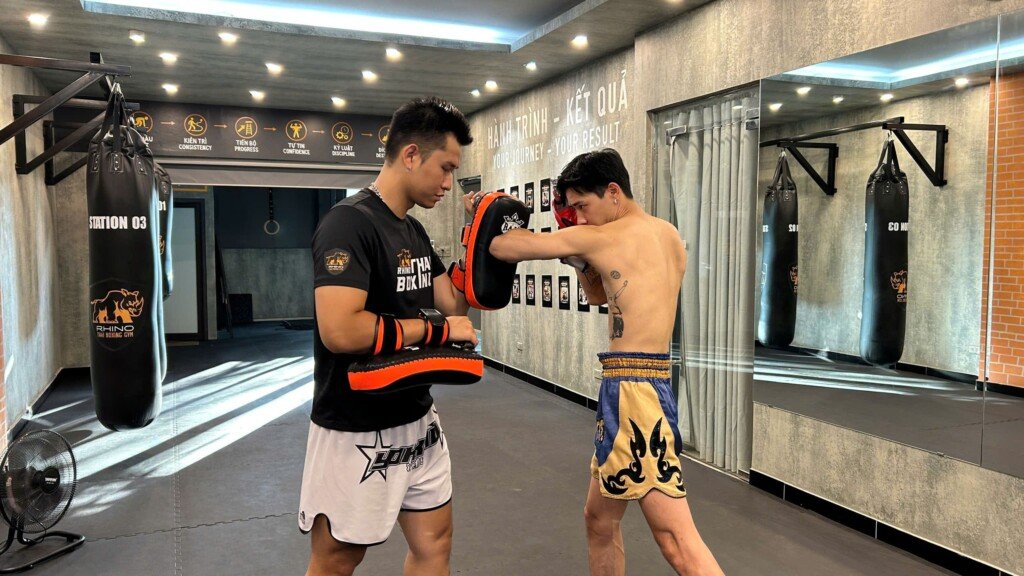
The bag does not push back, so your body learns a slightly wrong lesson about reaction force. That is a large part of why a coach threads pad work into the middle of a session: the distance keeps changing and you have to adjust, while the bag stays exactly where it was. If you want the movement order behind the punch before you add power to it, how to increase punching power works through the legs, hips and shoulders.
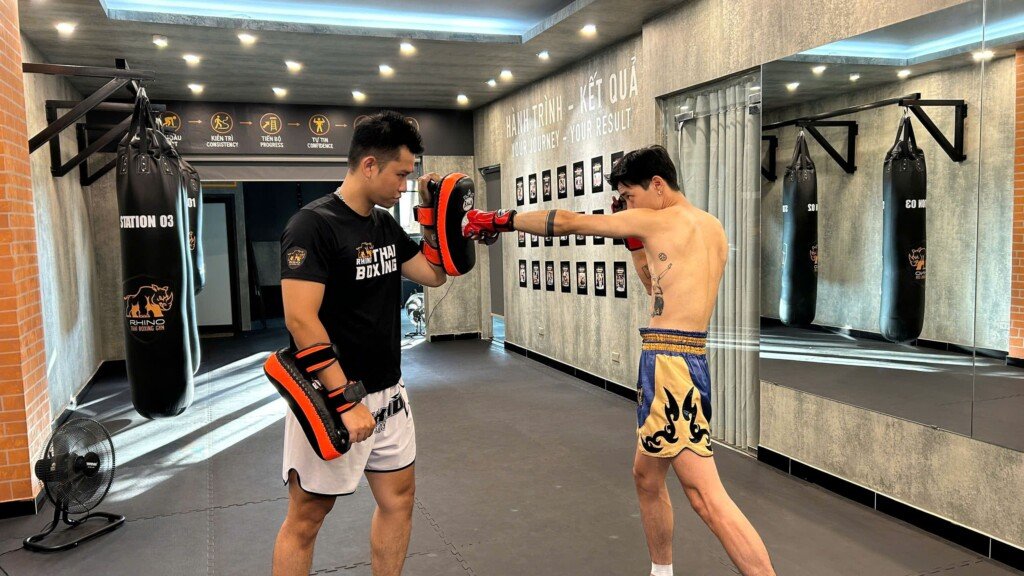
People ask me what heavy bag work is for if the coach still puts them on the pads. The bag gives you force and endurance. The pads give you timing — they move back, they change the angle, and I can stop the round the moment I see something wrong.
Coach Martin, Manager at RHINO
Not sure which part of your session is thin?
Tell RHINO your experience and what you want out of training. Sessions run as private 1-1, private 1-2 for two people who book together, or groups capped at six.
Does bag work build muscle or punching power?
Honest answer: heavy bag training is not resistance training, and nothing in the study above measured muscle growth. What the PlayerLoad numbers show is mechanical load through the body during a round — a description of what the session puts you through, not a claim about hypertrophy. Strength work is its own separate job.
Punching power is a different question again, and the bag’s role in it is narrow but real: it is where you find out whether a technically correct strike survives contact at speed. The sequence itself gets built somewhere else, mostly slowly and mostly without a target.

How private and group sessions use the three tools differently
In a private session a coach has both hands free for the whole hour, so pad work can take up much more of it, and the round stops the moment your technique starts to drift. In a 1-2 session two people alternate: one is on the pads while the other works the bag or shadow boxes, then they swap. That rotation is what keeps both people busy the whole time.
In a group capped at six, heavy bag training and shadow boxing take a larger share, because one coach cannot hold pads for six people at once. That does not make a group class worse — it gives it a different rhythm, with more uninterrupted round time and less individual correction. Private training in Hanoi sets out how each format actually runs.
FAQ
Can you hit the heavy bag every day?
It depends on how hard you hit, what shape you are in, and what else is in your week. Hands, wrists and shins need recovery time after contact, which is why many people alternate a lighter day in between. If a joint is still tender from yesterday, make today a shadow boxing day and keep the volume.
How long should a heavy bag workout be?
Round structure matters more than total length. Working in timed rounds with real rest keeps technique intact, and a well-run twenty minutes of that beats forty minutes of drifting. A coach sets the number of rounds from what you can hold form through, not from a clock target.
Is heavy bag training good cardio?
The continuous round structure is easy to sustain, which is what makes it useful for conditioning. This article gives no calorie number on purpose: the popular calculator sites do not publish how they measured, so a figure from them would be decoration. What can be said is that intensity depends on how you split your rounds and rest.
Do you still need a gym if you have a bag at home?
Heavy bag training at home gives you force and conditioning. What it cannot give you is someone watching the strike you cannot see yourself, or a target that changes distance. Plenty of people use a home bag on the days they cannot get in, then bring the accumulated errors to a session with a coach.
Heavy bag training benefits, in short: force, rhythm and endurance. Timing and accuracy need something that reacts to you. If you want a coach to look at what your current session is missing, call 091 2000 979 or send a question through the contact page. RHINO has two branches, at Dang Thai Mai and To Ngoc Van, both in Tay Ho.