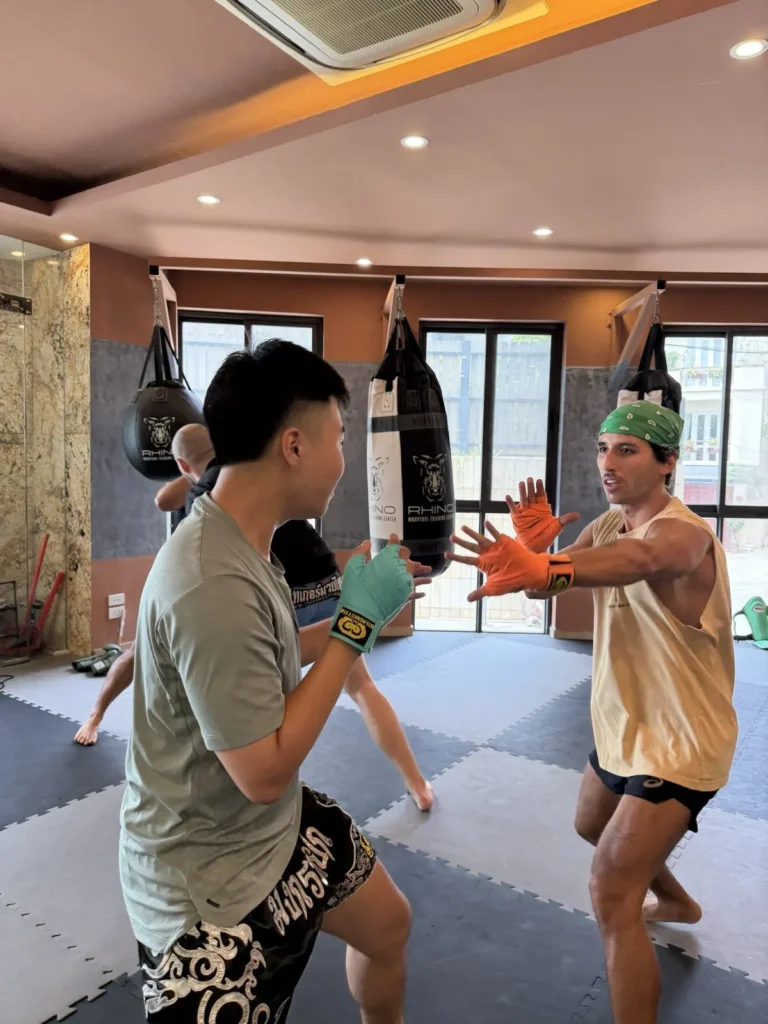

Boxing vs Muay Thai starts with one simple difference: boxing uses punches, while Muay Thai adds kicks, knees, elbows and clinch work. That wider set of tools changes the stance, movement, defensive habits, equipment and structure of a training session. Neither sport is automatically the better choice; the useful question is which kind of practice you want to return to each week.
If you enjoy detailed hand combinations, head movement and footwork, boxing gives you a narrow technical focus with enormous depth. If you want to involve the whole body and learn at long, middle and close range, Muay Thai offers more types of movement from the start.

Boxing vs Muay Thai at a glance
The quickest comparison is to look at what each ruleset allows. This table also includes K-1 kickboxing because many beginners use “kickboxing” and “Muay Thai” as if they meant the same thing.
| Technique | Boxing | K-1 kickboxing | Muay Thai |
|---|---|---|---|
| Punches | Yes | Yes | Yes |
| Kicks | No | Yes | Yes |
| Knees | No | Yes, with limits | Yes |
| Elbows | No | No | Yes |
| Clinch | No | Limited | A major part of the sport |
| Legal targets | Head and torso above the belt | Varies by ruleset | Head, body and legs, within the rules |
That difference is not cosmetic. A boxer can build every movement around punches because kicks, knees and elbows are outside the sport. A Muay Thai practitioner must remain ready to attack or defend with more parts of the body, including at clinch range.
1. The rules create two different technical systems
Under amateur boxing rules, a scoring blow lands with the knuckle surface of the glove on a legal target. Kicking, kneeing, elbowing, wrestling and holding are fouls. The legal target area covers the front and sides of the head and torso above the belt.
Muay Thai allows far more striking tools. The International Federation of Muaythai Associations describes punches, kicks, knees and elbows as the sport’s core weapons. Clinch work adds another layer: athletes fight for posture and position at close range, use knees and disrupt balance.
This is why counting “eight limbs” is only the beginning of the answer. More weapons mean more transitions between ranges, more defensive choices and more ways to lose balance if the feet are late. Boxing has fewer weapon groups, but that lets students spend far more time refining punch mechanics, timing, angles and defensive reactions.
2. Boxing vs Muay Thai stance and movement
The boxing vs Muay Thai stance difference begins with the attacks each person must defend. A typical boxing stance supports quick punching combinations, head movement and changes of angle. The feet drive the hands, but the boxer does not need to check a low kick or prepare to throw one.
A Muay Thai stance must account for attacks to the legs as well as the head and body. The practitioner needs to lift a leg to check a kick, return a kick without a long reset and stay balanced when entering or leaving the clinch. The torso is generally more upright because deep slips can move the head toward a knee or kick.
These are tendencies, not one fixed pose used by every athlete. Coaches adjust stance to the person, the drill and the rules. The important point is that a boxing vs Muay Thai stance comparison makes sense only when you ask what attacks each person must be ready to defend.
RHINO’s guide to how to throw a low kick shows how the support foot, hip and recovery position work together in one common Muay Thai strike.

3. Kickboxing and Muay Thai are not identical
“Kickboxing” covers more than one competition format. The WAKO ring rules separate Full Contact, Low Kick and K-1, and each format permits a different set of targets and techniques.
- Full Contact allows punches and kicks to the head and torso, but not kicks to the legs, knees, elbows or clinching.
- Low Kick adds kicks to the thigh, but still excludes knees, elbows and clinching.
- K-1 permits low kicks and knees and allows only limited holding. Elbows remain illegal.
K-1 is the closest of these formats to Muay Thai, but the sports still feel different at close range. Muay Thai includes elbows and develops clinch control as a full technical area rather than a brief transition. The RHINO article on the Muay Thai clinch explains how posture, foot position and balance matter before strength does.
4. Equipment reflects the legal techniques
In a boxing vs Muay Thai equipment comparison, both sports begin with hand wraps and gloves. Contact drills in boxing may also require a mouthguard and headgear, depending on the session. Beginners do not need to buy every item before their first class; ask what the gym provides and what the coach expects you to bring.
Muay Thai also uses wraps and gloves, then adds shin guards for controlled partner work. A mouthguard, headgear or elbow pads may be required for particular drills. The extra equipment exists because both the attack surface and the legal target area extend beyond the hands and upper body.

Buy equipment in stages. Wraps work for both sports. Gloves and shin guards are easier to choose after you know the class format, the level of contact and the gym’s own equipment rules.
5. Boxing vs Muay Thai for fitness and a first session
Both sports can provide demanding conditioning, coordination work and repeated high-effort intervals. Boxing sessions often place more continuous emphasis on footwork, punch volume and upper-body rhythm. Muay Thai adds kicking, kneeing and clinch movements, so the hips, legs and balance take on a larger role.
For a beginner, boxing vs Muay Thai feels different before either session becomes advanced. In a first boxing session, a student may work on stance, guard, jab, cross and the step that supports each punch. Fewer weapon groups give the coach more room to correct small details in the hands and feet.
A first Muay Thai session may combine stance, punches, one basic kick and the return to balance. A responsible beginner class does not try to teach punches, kicks, knees, elbows and clinch all at once. The coach introduces a manageable piece, then adds combinations as the student’s coordination improves.
For boxing vs Muay Thai for fitness, consistency matters more than an abstract winner. Choose the movement you find engaging enough to practise regularly. A theoretically perfect workout has little value if you dislike it and stop attending.
“To me, Thai Boxing is much more than a combat sport.”
ManChai, RHINO founder, on the RHINO About page
Not sure which class fits?
Send RHINO your goals, schedule and any areas that have been painful before. The team can explain the practical difference between boxing and Muay Thai. RHINO offers Private 1-1, Private 1-2 and Group 1-6 training.
6. Skills transfer, but habits also need adjusting
When students switch between boxing vs Muay Thai, useful skills transfer in both directions. Guard awareness, punching mechanics, hand-eye coordination and the habit of moving the feet with the hands all carry value. RHINO’s guide to increasing punching power applies to force transfer through the body, not to one sport alone.
The transfer is not complete, however. A boxer moving into Muay Thai needs to adapt stance, learn to check kicks and add knees, elbows and clinch work. Some deep slips or rolls also need adjustment because lowering the head can bring it toward a knee or kick under Muay Thai rules.

The reverse move also requires adaptation. A Muay Thai student entering a boxing class may need a lighter rhythm, more active head movement and more specialised defensive responses to punch combinations. Existing experience helps, but the student still has to respect the new ruleset.
Which one should a beginner choose?
Use three practical questions instead of trying to rank the sports:
- Do you want to specialise in punches? Boxing gives more training time to punch mechanics, footwork, angles and defence against the hands.
- Do you want to use the whole striking toolkit? Muay Thai includes punches, kicks, knees, elbows and clinch work, so the learning path covers more ranges.
- Do you have an existing issue with a knee, hip, ankle, wrist or shoulder? Tell the coach before training so the session can be adjusted. A coach can modify a drill, but diagnosis belongs to a qualified medical professional.
At RHINO, the delivery format is a separate choice from the sport. Private 1-1 gives one trainee the coach’s full attention. Private 1-2 lets two people book together with one coach, while Group 1-6 creates a small shared session. The right format depends on your goals, schedule and how much individual correction you want, not on a rule that one option is always better.
How class format changes the boxing vs Muay Thai experience
The sport determines the techniques, but the class format changes how you learn them. In Private 1-1 training, the coach can spend more time on your boxing vs Muay Thai stance, balance and recurring technical habits. That format can be useful when you want frequent correction or need drills adjusted around a previous area of pain.
Private 1-2 is for two people who book together with one coach. The pair can practise timing and controlled partner drills while still receiving more direct attention than in a group. If two friends are making the muay thai vs boxing decision together, they can also try the same lesson and compare how each set of movements feels.
Group 1-6 training adds shared rhythm and a wider mix of partners. The coach divides attention across the class, so it suits people who enjoy learning alongside others and do not need every repetition corrected. A boxing vs Muay Thai for fitness decision may feel different in this setting because pace, partner work and class energy become part of the experience.
None of these formats changes the basic boxing vs Muay Thai distinction. Boxing still specialises in punches, and Muay Thai still adds kicks, knees, elbows and clinch. The format only changes the amount of individual feedback and partner interaction around those skills.
Frequently asked questions
Is Muay Thai harder than boxing?
In boxing vs Muay Thai, Muay Thai has more weapon groups, so a beginner meets more types of movement. Boxing uses fewer strike types but develops deep technical detail in punching, footwork, angles and defence. What feels harder depends on your coordination, mobility and interests.
Which is better for fitness, Muay Thai vs boxing?
Both can build conditioning, coordination and full-body work. Boxing often concentrates more volume in footwork and punching, while Muay Thai adds repeated kicks, knees and clinch movements. The better fitness choice is the one you can practise consistently and safely.
Do I need to learn boxing before Muay Thai?
No. The boxing vs Muay Thai learning order is not a fixed ladder. A beginner Muay Thai class teaches stance and basic punches before combining them with kicks and other tools. Boxing experience can help, but it is an advantage rather than a prerequisite.
Can a boxer switch to Muay Thai?
Yes. Punching experience transfers, but the boxer must learn defence against kicks, knees and elbows and must adjust to clinch range. Stance and head movement may also need changes.
Are kickboxing and Muay Thai the same?
No. Kickboxing contains several rulesets. K-1 is the closest common format to Muay Thai, but it excludes elbows and limits holding, while Muay Thai develops both elbows and clinch work.
In short, boxing vs Muay Thai is a choice between two different technical systems. Boxing specialises in punches, footwork and defence against the hands. Muay Thai adds kicks, knees, elbows and clinch work. To ask about trying either one at RHINO, call 091 2000 979 or use the contact page. RHINO trains at Dang Thai Mai and To Ngoc Van, both in Tay Ho.