
Strength training for runners in Hanoi usually starts as a fix for something: a knee that complains at 8km, a pace that stalls, or a training plan that has added mileage for months and nothing else. What the research supports is narrower than most gym marketing suggests, and knowing where the line sits saves you from buying the wrong thing.
Here is what the evidence on strength training for runners in Hanoi actually says, what it does not say, and what a coached session adds over a solo gym visit. The session shape described below is an editorial proposal, not RHINO’s official programme — a coach adjusts it to your mileage, your race calendar and your injury history.

Strength training for runners in Hanoi: 4 findings from the evidence
The best current summary is a 2024 systematic review with meta-analysis in Sports Medicine, pooling 31 studies and 652 middle- and long-distance runners across programmes of 6 to 24 weeks. It compared strength training methods against running-only control groups, and the differences between methods are the useful part:
- Heavy strength work (at or above 80% of a one-rep maximum) produced a small improvement in running economy, with a stronger effect at faster running speeds.
- Plyometric training produced a small improvement, and mainly at speeds of 12 km/h or slower.
- Combining methods gave the largest effect of the three, though the review rated the certainty of that particular finding as low.
- Submaximal loads and isometric work showed no improvement in running economy compared with the control groups.
Two limits belong next to those results. The certainty of evidence was moderate at best and low for the combined approach, so this is a direction rather than a guarantee. And the participants were trained runners aged 17 to 45 — the review says nothing about someone six weeks into their first 5k.
A separate narrative review in Sports covers the same ground for running biomechanics and injury risk. A narrative review is a weaker design than a meta-analysis, so treat it as context, not proof.
What none of this establishes: that holding pads or hitting a bag improves running economy. Combat-sport conditioning is enjoyable, and it does build general work capacity, but the studies above tested squats, deadlifts and jumps. If your goal is a faster 10k, the strength part is what has the evidence behind it, and this article will not pretend otherwise.
Strength and conditioning for runners: the parts that matter
Strength and conditioning for runners is mostly unglamorous, and that is the first thing to accept. Heavy, low-repetition lower-body work; single-leg movements, because running is a single-leg activity; some jumping if your joints tolerate it; and enough posterior-chain work that your hamstrings and calves are not the last line of defence at kilometre 18.
Two sessions a week is what most of the reviewed programmes used, and they ran between 6 and 24 weeks before measuring anything. Any plan for strength training for runners in Hanoi has to survive that timeline, not a fortnight. That timeline matters more than the exercise list. A month of gym work before a race is unlikely to change your economy; it is likely to leave you sore at the wrong moment.

What a coached session adds: 3 things you cannot do alone
A coach is not selling you exercises you could not look up. What they provide is the three things a solo session cannot:
- Load selection on the day. Heavy work only works if the load is genuinely heavy for you and genuinely manageable after the week you have had. That judgement changes session to session.
- Technique under fatigue. A squat that holds at rep 3 and collapses at rep 8 is where injuries come from, and you cannot see your own hips from inside the movement.
- Knowing when to cut the session. This is the one runners skip. The day after a long run, or the week of a race, the right session is shorter than the planned one.
That last point is why the timing question matters more than the programme. Heavy legs the day before a key run costs you the run, and stacking a hard gym session on top of an interval day stacks the fatigue too.

Cross training for runners: where combat sport honestly fits
Cross training for runners is worth separating from strength work, because they do different jobs and the evidence for them is not the same. Both belong in a plan; only one of them has running-economy data behind it. Combat-sport training brings variety, coordination, upper-body and core work, and a session where you think about something other than pace. Those are real benefits and they keep people training through a Hanoi August when running outdoors is unpleasant. For most people asking about cross training for runners, that consistency is the actual win.
| What you want | What actually addresses it | Evidence |
|---|---|---|
| Better running economy | Heavy lower-body strength, plyometrics | Meta-analysis, moderate certainty |
| Durability through a mileage block | Progressive strength work, single-leg | Narrative review, weaker design |
| Variety, coordination, indoor option | Muay Thai, Combat Fit, pad work | No running-economy claim made |
| A day off your legs | Technique work at low intensity | Coach’s judgement, not a study |
Read the bottom two rows as honestly as the top two. A Muay Thai class is a good indoor session on a day you do not want to run; it is not a substitute for squats if the goal is a faster half marathon.
Hanoi adds its own reason to have an indoor option. Heat, humidity and air quality all vary through the year, and the air quality question is one every runner here eventually has to make a decision about.
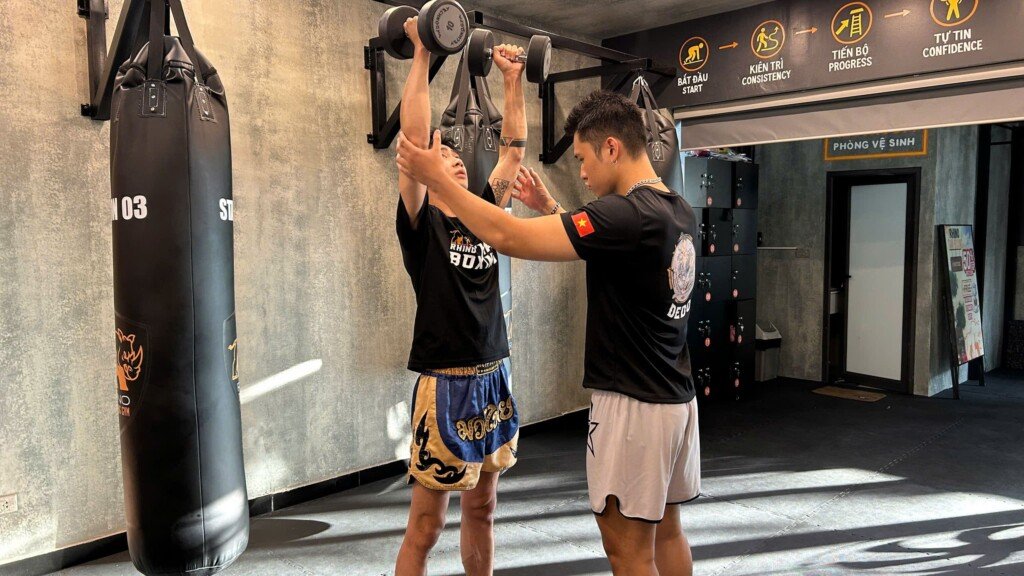
Runners come in strong in a straight line and shaky on one leg. I load what they can hold together under fatigue, and on the day after a long run I cut the session — nobody gets faster from a session they should have skipped.
— Coach James, Manager at RHINIO
Training for a race and not sure where strength fits?
Tell RHINO your weekly mileage, your race date and any current niggles. Sessions run as private 1-1, private 1-2 for two people who book together, or groups capped at six.
Fitting it around your running week
Scheduling strength training for runners in Hanoi is simple even when the week is not: protect your key runs, and let the strength work take the leftover days. If your long run is Sunday, heavy legs on Saturday is the wrong choice. Two strength sessions placed on easy-run days, or straight after a quality run rather than the day before one, is the arrangement most of the reviewed programmes used.
Race weeks are the exception worth stating plainly, and they are where strength and conditioning for runners goes wrong most often. Reduce the volume and keep the movement pattern rather than dropping strength entirely, and do not introduce a new exercise inside the final fortnight. Soreness from an unfamiliar movement is a bad way to find out how your calves feel at kilometre 30.
If you are deciding between session formats, the private training guide explains how 1-1, 1-2 and group sessions differ in coach attention, and the two RHINO locations in Tay Ho article covers both gyms if you are picking by commute.

FAQ
How many strength sessions a week do runners need?
Most of the programmes in the 2024 meta-analysis of strength and conditioning for runners used one to four sessions a week, with two being common, over 6 to 24 weeks. There is no single correct number: it depends on your mileage, your recovery and what else is in the week. That is a conversation with whoever writes your running plan.
Will strength training make me heavier and slower?
The reviewed programmes improved running economy rather than harming it, and heavy low-repetition work is not the same stimulus as bodybuilding volume. If you are adding a lot of mileage at the same time, weight gain is unlikely to be the limiting factor anyway.
Is strength training for runners in hanoi different from anywhere else?
The exercises are not. What differs is the calendar: heat, humidity and air quality here push people indoors for parts of the year, so an indoor strength or combat session is often the realistic option rather than a nice extra.
Can I do cross training for runners instead of strength work?
They answer different questions. Cross training for runners keeps you moving and gives your legs a break from impact; heavy strength work is what has running-economy evidence behind it. If you only have time for one and your goal is a race time, do the strength work.
Do I need to be a runner to train here?
No. Most people at RHINO are not training for a race, and a coach will build around whatever your week already contains. Cross training for runners is one reason people come in; it is not the only one.
Strength training for runners in Hanoi is worth doing for the evidence-backed part, and worth being honest about for the rest. If you want someone to look at your current week before adding anything, call 091 2000 979 or send a question through the contact page. RHINO has two gyms in Tay Ho: Branch 1 at 87 Alley 50 Dang Thai Mai, Quang An, Tay Ho, Hanoi, and Branch 2 at 23 Alley 52 To Ngoc Van, Tay Ho, Ha Noi.