
Starting muay thai for beginners Hanoi is less dramatic than it looks from outside. You will spend a first class learning to stand, to move, and to put a straight punch on a pad — not sparring, not getting hit, and not being asked to be fit before you arrive. The thing worth knowing in advance is what actually happens in the room, so you can stop wondering and just turn up.
This guide to muay thai for beginners Hanoi covers the seven questions that come up most: what a first class involves, what to bring, what the injury data genuinely says about beginners, the mistakes coaches correct most often, how often people train, how private and group sessions differ for someone new, and where to go in Tay Ho. No sales pitch, and no price table — the pricing article has the numbers if you want them.

1. What your first muay thai class actually involves
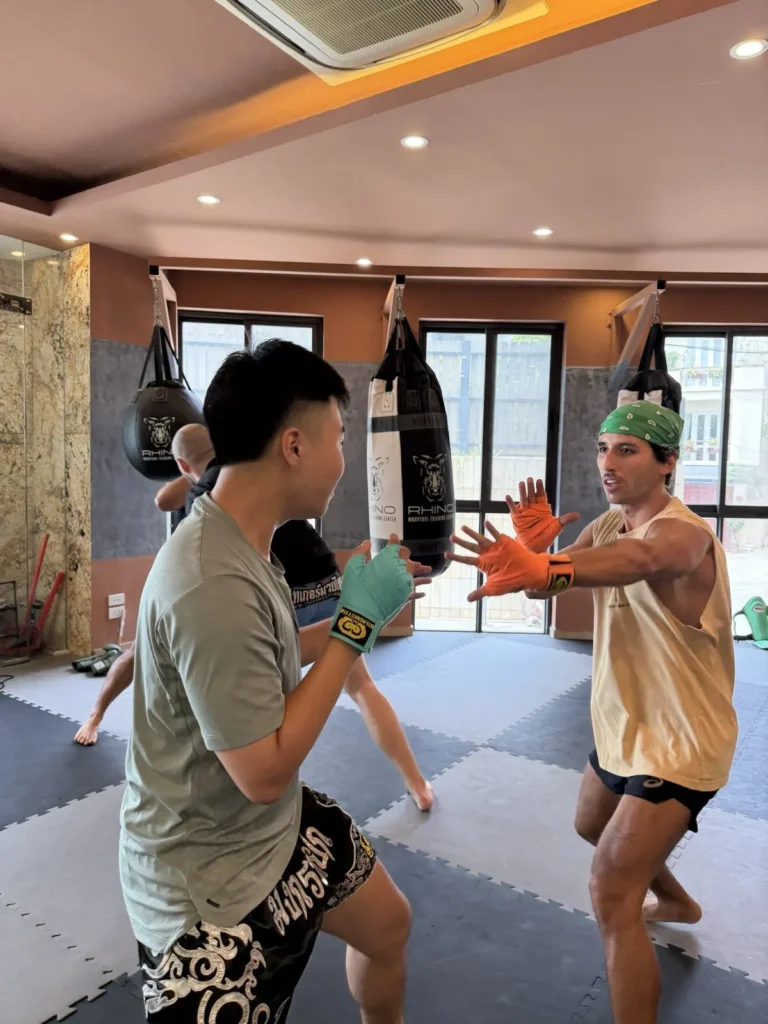
A first muay thai class follows roughly the same shape in most gyms, and knowing the shape removes most of the nerves. Nothing in a first muay thai class is a test.
You arrive, check in, and put your things away. There is a warm-up the whole room does together — skipping, mobility, shadow work — which is where most of the sweating happens. Then the coach shows one or two techniques, breaks them into parts, and walks the room while people try them. After that you hit something: a coach’s pads, a partner’s pads, or a bag. The class winds down with stretching, and people usually stand around talking afterwards.
Nobody spars in a first muay thai class. Beginners are not put in front of a partner to be hit, and any gym that does that on day one is doing something unusual.
The one part that genuinely varies is how much individual correction you get, and that depends on the format rather than the gym. More on that in section 6.
2. What to bring, and what the gym lends
Short list. Shorts, a t-shirt, a towel, water, and a form of shoes you can leave at the edge of the mat — Muay Thai is trained barefoot.
Gloves are almost always lent for a trial session, so you do not need to buy anything before your first muay thai class. The one item worth owning early is hand wraps: they are the cheapest protective equipment in the sport, and they keep borrowed gloves usable for the next person. The hand-wrapping guide covers the sequence and the fit check, and it is a five-minute skill you will use every session for years.
Shin guards come later, once you are kicking pads regularly. They are not a first-week purchase, and no coach will expect you to arrive with a full kit.
| Item | First muay thai class | Later |
|---|---|---|
| Shorts, t-shirt, towel, water | Bring | — |
| Gloves | Borrow from the gym | Buy when you are training regularly |
| Hand wraps | Borrow or buy | Own a pair, ideally two |
| Shin guards | Not needed | Once you kick pads regularly |
| Mouthguard | Not needed | Only if you start partner work |

3. Beginners get injured more often than professionals, and the number is public
This is the section most beginner guides skip, and it is the one worth reading carefully — including the caveats, which matter as much as the figure.
A study in the British Journal of Sports Medicine surveyed injury rates across experience levels in Muay Thai. Gartland and colleagues reported annual injury rates of 13.5 per 1000 participants for beginners, against 2.43 per 1000 for amateurs and 2.79 per 1000 for professionals. Among beginners, 7% of injuries led to seven or more days off training; for amateurs and professionals those figures were 4% and 5.8%.
Read the denominator before you read the number. That is per 1000 participants per year, not per 1000 hours of training — and professionals train vastly more hours than beginners do, so this is not saying a beginner is in more danger per session. What it is saying is that in a given year, a higher share of beginners picks up something than a higher share of professionals does, which is what you would expect from people doing unfamiliar movements with unconditioned tissue.
Two more limits. It is a 2001 study, so equipment and coaching practice have moved since. And it relies on self-report, which cuts both ways: beginners may report a sore shin that a professional would not bother mentioning.
What to do with it is simple and unexciting. The first month is the month to be conservative, ask about anything that hurts in a joint rather than a muscle, and let the coach set your kicking volume. The injuries article covers what actually turns up in a first year, and it is not a substitute for a doctor.
4. Muay thai beginner mistakes coaches correct most
The muay thai beginner mistakes below are not exotic, and every one is fixable in a single session once somebody points it out. The common muay thai beginner mistakes are mostly about effort in the wrong place.
| Mistake | What you notice | The correction |
|---|---|---|
| Holding your breath through a combination | You are gassed after 30 seconds | Breathe out on each strike |
| Wrapping hands too tight | Fingers tingle, hand goes cold | Firm at the wrist, open hand still opens |
| Punching with a bent wrist | Wrist aches after pad rounds | Straight line from knuckles to forearm |
| Kicking with the instep, not the shin | Sore foot after class | Contact on the lower third of the shin |
| Dropping the hands to kick harder | Coach keeps tapping your head | Same guard, smaller kick |
| Trying to match the fittest person in the room | You stop coming in week three | Your own pace, every round |
The last row is not a technique problem at all, and of all the muay thai beginner mistakes it is the one that ends the most beginnings. A class has people in it who have trained for years, and matching their output in week one is neither possible nor the point.
Four of the first five muay thai beginner mistakes come from one instinct: more force will make it work. Usually less force and a better line makes it work, which is why punching power turns out to be a technique subject rather than a strength one.

5. How often should I train muay thai when starting out?
How often should I train muay thai is the question with the least honest generic answer, because it depends on your schedule, your recovery and what you want. What can be said is what the public health guidance describes and what tends to happen in practice.
WHO recommends that adults get 150 to 300 minutes of moderate-intensity activity a week, or 75 to 150 minutes of vigorous-intensity activity, plus muscle-strengthening work on two or more days. A Muay Thai class sits at the vigorous end for most beginners, so two or three sessions a week lands inside that range with room to spare. That is a description of a guideline, not a prescription for you.
Asked how often should I train muay thai in month one, most coaches answer with tissue rather than enthusiasm. Shins, wrists and hips need time to adapt, and the people who train four times in their first week are usually the people who train zero times in their third. Nobody here is going to tell you a number of sessions to buy — what each format gives you is below, and the choice is genuinely yours.
6. Private, 1-2 or group: what actually changes for a beginner
RHINO runs three formats, and the difference for someone new is the amount of correction per hour.
Private 1-1 puts a coach on you for the whole session. For a beginner that means every rep gets watched, and a fault gets caught in the first few repetitions instead of the fiftieth. It is the fastest way to get a stance and a guard that do not need unlearning later. The private training guide goes into how a session is structured.
Private 1-2 is two people who book together and alternate with one coach. You get most of the individual attention and you get a built-in training partner, which some people find makes the difference between going and not going.
Group classes, capped at six, still include technique and pad work — the coach’s observation time is simply divided across the room. Plenty of people learn perfectly well this way, and a smaller cap is the whole reason it works.
There is no format that is correct for everyone, and which one suits you depends on your schedule, your budget and how much detailed correction you want. If you would rather try before committing to anything, a single drop-in session exists for exactly that.
Nobody arrives fit. People think they should get in shape first and then come, and it is the wrong way round — you get in shape by coming. What I watch in the first month is whether someone is breathing and whether they are enjoying it. Technique I can fix any time.
— MANCHAI, Founder of RHINO
Want to try one class before deciding anything?
RHINO runs private 1-1, private 1-2 for two people who book together, and group classes capped at six. Gloves are available to borrow.
7. Where to train muay thai for beginners Hanoi classes in Tay Ho
RHINO has two gyms, both in Tay Ho: Branch 1 at 87 Alley 50 Dang Thai Mai, Quang An, Tay Ho, Hanoi, and Branch 2 at 23 Alley 52 To Ngoc Van, Tay Ho, Ha Noi. Tay Ho is Hanoi’s expat district, and having two locations inside it means one of them is usually the closer one — the two-locations article has both in detail.
Whichever gym you end up at, the thing that decides whether you keep training is travel time. A gym 10 minutes away that is merely good beats a gym 40 minutes away that is excellent, because you will actually go to the first one. Work out the journey before you compare anything else.

What comes after the first month
Most guides to muay thai for beginners Hanoi stop at week one. Once the stance stops requiring thought, the interesting part starts. Kicks get their own mechanics — the low kick is usually the first one taught, because it is the easiest to stay balanced on. Later the clinch opens up, which is the part of Muay Thai that exists in almost no other striking sport.
None of that is urgent. A beginner’s whole job in month one is to turn up, breathe, and not wrap their hands too tight.

FAQ
Do I need to be fit to start muay thai for beginners Hanoi classes?
No, and this is the most common reason people delay for months. Classes contain people at every level of fitness, and the warm-up is something you work through at your own pace rather than a test you pass. Getting fit is what the training is for.
What happens in a first muay thai class if I have never done any sport?
The same thing that happens for everyone else, slower. A coach will show you a stance, a guard and one or two strikes, and you will spend the class on those rather than on a long list. Being new to sport in general mostly means the warm-up feels harder, not that the technique does.
Will I get hit in my first muay thai class?
Not in any normal beginner session. Partner work starts with holding pads for each other, which involves no striking of people at all, and sparring comes much later and by agreement. If a gym puts a first-timer into contact work on day one, that is a reason to ask questions.
How long before I stop feeling like a complete beginner?
Most people describe the stance and guard becoming automatic somewhere in the second month of regular training, which is also when the warm-up stops being the hardest part of the class. That is a pattern, not a promise — it depends on how often you train and what you did before.
How often should I train muay thai to see a change in fitness?
How often should I train muay thai has guidance rather than a rule behind it: WHO’s figure is 150 to 300 minutes of moderate or 75 to 150 minutes of vigorous activity a week for adults, and Muay Thai classes generally count as vigorous. Where you sit inside that is a decision about your schedule and recovery, and a coach can help you plan it once they have seen you train.
Is muay thai for beginners Hanoi suitable if I am over 40?
Age is far less relevant than injury history and how gradually you build up. Tell the coach about any old knee, shoulder or back problem before the first class, and get medical advice first if you have a heart or respiratory condition — this article cannot give you that.
The short version of muay thai for beginners Hanoi: bring shorts and water, borrow the gloves, do not wrap your hands too tight, and go at your own pace for the first month. If you want to ask something before booking, call 091 2000 979 or use the contact page. Both RHINO gyms are in Tay Ho — Dang Thai Mai and To Ngoc Van.