
Muay Thai weight classes come in two main systems. Amateur Muay Thai, run by IFMA, uses kilogram classes from 45 kg up to +91 kg for men and +75 kg for women. Professional bodies such as WBC Muaythai use pound divisions from 105 lb (Mini Flyweight) up to Heavyweight. If you only train for fitness, you do not need a weight class at all, but the charts are useful to understand once you start watching fights or think about competing one day.
This guide puts every chart in one place for 2026: the IFMA kilogram classes, the WBC and WMC pound divisions, why the charts disagree at the top end, how weigh-ins work and how to work out which class you would sit in. All figures come straight from the governing bodies’ own rulebooks, not from fan sites.
Muay Thai Weight Classes at a Glance
Before the full tables, here is the short version of how Muay Thai weight classes are organised. The two systems you will meet most often are the amateur IFMA chart, used at world and continental championships, and the professional charts used by WBC Muaythai and WMC. They measure in different units, use different glove weights and weigh athletes at different times.
| System | Level | Unit | Number of classes | Competition glove | Weigh-in timing |
|---|---|---|---|---|---|
| IFMA | Amateur, elite adults | kg | 14 men, 11 women | 10 oz for everyone | Same day, at least 3 hours before the first bout |
| WBC Muaythai | Professional | lb | 18 divisions | 8 oz up to Welterweight, 10 oz from Super Welterweight | 24 to 30 hours before the fight |
| WMC | Professional | lb | 20 divisions | Set by the event | No more than 24 hours before |
The point to take away is that “lightweight” or “71 kg” only means something once you know which organisation is running the event. Amateur events run under IFMA rules use kilograms, while many professional cards use pounds.
Muay Thai Weight Classes in kg: The IFMA Amateur Chart
IFMA, the International Federation of Muaythai Associations, sets the amateur rules used at its world championships and by its member federations. The current IFMA Rules & Regulations, revised on 11 May 2026, list the Muay Thai weight classes in kg in Rule 4. Each number is an upper limit, so “57 kg” means over 54 kg and up to 57 kg.
| # | Men (elite and U24) | Women (elite and U24) |
|---|---|---|
| 1 | 45 kg (selected multi-sport events only) | 45 kg |
| 2 | 48 kg | 48 kg |
| 3 | 51 kg | 51 kg |
| 4 | 54 kg | 54 kg |
| 5 | 57 kg | 57 kg |
| 6 | 60 kg | 60 kg |
| 7 | 63.5 kg | 63.5 kg |
| 8 | 67 kg | 67 kg |
| 9 | 71 kg | 71 kg |
| 10 | 75 kg | 75 kg |
| 11 | 81 kg | +75 kg |
| 12 | 86 kg | |
| 13 | 91 kg | |
| 14 | +91 kg |
Two details are easy to miss. The men’s 45 kg class only runs at selected multi-sport events, so most championships start the men’s chart at 48 kg. The women’s chart stops at 75 kg, and everyone above that competes together in the +75 kg class. Elite athletes must be 18 to 40, and IFMA runs separate youth charts from U8 to U18 with much lighter limits, starting at 16 kg for the youngest group.

Professional Muay Thai Weight Classes in Pounds
Professional Muay Thai grew up in Thailand’s stadiums and borrowed its division names from boxing, which is why the pro charts use pounds. The WBC Muaythai rules list 18 divisions in Rule 5. As with IFMA, each figure is the maximum for that division.
| Division | Limit (lb) | Limit (kg) |
|---|---|---|
| Minimumweight (women only) | 100 | 45.359 |
| Mini Flyweight | 105 | 47.627 |
| Light Flyweight | 108 | 48.987 |
| Flyweight | 112 | 50.802 |
| Super Flyweight | 115 | 52.163 |
| Bantamweight | 118 | 53.524 |
| Super Bantamweight | 122 | 55.338 |
| Featherweight | 126 | 57.153 |
| Super Featherweight | 130 | 58.967 |
| Lightweight | 135 | 61.235 |
| Super Lightweight | 140 | 63.503 |
| Welterweight | 147 | 66.678 |
| Super Welterweight | 154 | 69.853 |
| Middleweight | 160 | 72.575 |
| Super Middleweight | 168 | 76.204 |
| Light Heavyweight | 175 | 79.379 |
| Cruiserweight | 200 | 90.718 |
| Heavyweight | over 200 | over 90.718 |
Notice how tightly packed the lighter divisions are. Between 105 lb and 140 lb there are ten divisions, often only 3 or 4 pounds apart, which is about 1.4 to 1.8 kg. That reflects the history of the sport in Thailand, where most professional athletes have competed in the lighter weights.
Why Muay Thai Weight Classes Differ Between Organisations
If you compare Muay Thai weight classes online, you will find they agree up to Light Heavyweight and then split. The WMC rules on weight divisions add a Super Light Heavyweight class and set the heavier limits differently from WBC Muaythai.
| Division | WBC Muaythai | WMC |
|---|---|---|
| Pinweight or Minimumweight | 100 lb, women only | 100 lb (45.45 kg) |
| Light Heavyweight | 175 lb | 175 lb |
| Super Light Heavyweight | not used | 182 lb (82.55 kg) |
| Cruiserweight | 200 lb | 190 lb (86.18 kg) |
| Heavyweight | over 200 lb | 209 lb (95 kg) |
| Super Heavyweight | not used | over 209 lb |
So the same athlete at 88 kg would be a Cruiserweight under WBC Muaythai and a Heavyweight under WMC. Neither chart is wrong. They are simply two organisations’ rules, and the event poster tells you which one applies. Promotions such as ONE Championship also publish their own limits, so always check the rules of the specific event rather than a generic chart.
How Muay Thai Weigh-Ins Work
A weight class only works if everyone is weighed the same way, so each rulebook sets out the weigh-in procedure in detail. The biggest difference between amateur and professional rules is timing.
Under IFMA rules, a doctor checks each athlete immediately before they step on the scale, and athletes weigh in wearing light underwear. They get only one attempt per day, and the reading on that attempt is final. Bouts start no earlier than three hours after the weigh-in closes. Officials can also re-weigh an athlete before the bout, and anyone found 5% over their class limit is disqualified.
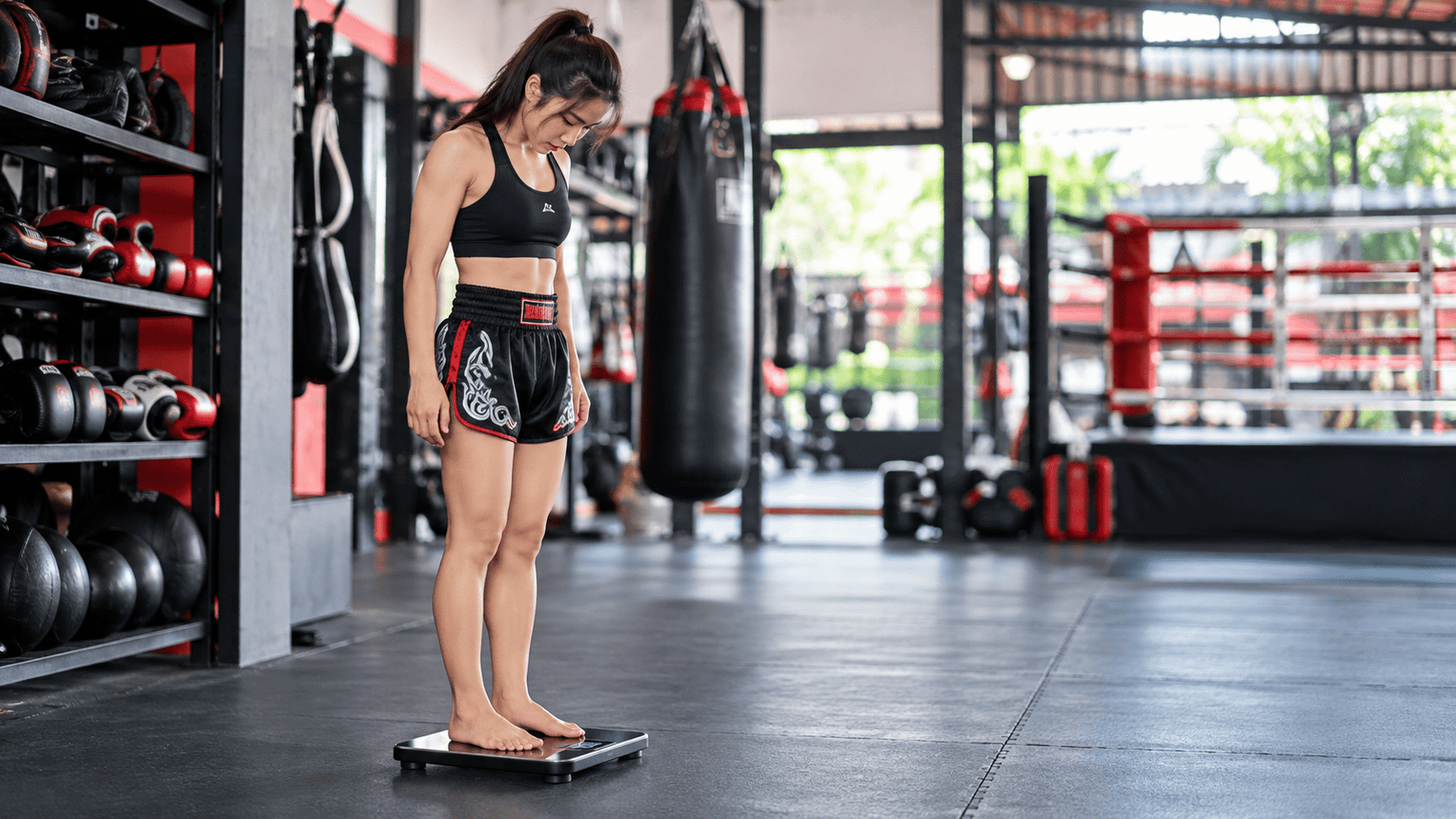
Professional rules give more time. WBC Muaythai weighs fighters 24 to 30 hours before the fight, with a doctor’s check beforehand, although its rules allow exceptions, including same-day weigh-ins, for championships held in Thailand. WMC weighs no more than 24 hours before the contest. WMC also states that two opponents must not be more than 5 pounds apart, which is about 2.3 kg.
Glove Weight and Weight Class
Glove weight is tied to weight class in professional Muay Thai, which is one reason the charts matter even outside the ring. WBC Muaythai uses 8 oz gloves from Minimumweight up to Welterweight and 10 oz gloves from Super Welterweight up to Heavyweight. IFMA keeps it simple: every amateur athlete wears 10 oz gloves, weighing 284 grams.
| Rulebook | Lighter divisions | Heavier divisions |
|---|---|---|
| IFMA (amateur) | 10 oz | 10 oz |
| WBC Muaythai (pro) | 8 oz, up to 147 lb | 10 oz, from 154 lb |
These are competition gloves, built for a single contest under supervision. Training gloves are a different question, and they are usually heavier and more padded so partners can drill safely week after week. If you are buying your first pair, ask your coach before choosing a size, because the right weight depends on your hands, your build and how you will use the gloves.

What Muay Thai Weight Class Am I?
Working out what Muay Thai weight class am I takes three steps. You only need a scale and the chart for the event you are curious about.
- Weigh yourself in the morning. Do it before breakfast, in light clothing, on the same scale each time. Your weight moves by a kilo or more across a normal day.
- Pick the chart. Use the IFMA kilogram chart for amateur events and the organisation’s own pound chart for a professional event.
- Find the first limit above your weight. You belong in the lowest class whose upper limit is at or above your morning weight.
Here is how that works for a few example weights. The pound figures are the kilogram weight multiplied by 2.20462, rounded to one decimal place.
| Morning weight | IFMA class | WBC Muaythai division |
|---|---|---|
| 52 kg (114.6 lb) | 54 kg | Super Flyweight (115 lb) |
| 55 kg (121.3 lb) | 57 kg | Super Bantamweight (122 lb) |
| 62 kg (136.7 lb) | 63.5 kg | Super Lightweight (140 lb) |
| 68 kg (149.9 lb) | 71 kg | Super Welterweight (154 lb) |
| 80 kg (176.4 lb) | 81 kg (men), +75 kg (women) | Cruiserweight (200 lb) |
| 95 kg (209.4 lb) | +91 kg (men), +75 kg (women) | Heavyweight (over 200 lb) |
The 62 kg example shows a neat overlap. IFMA’s 63.5 kg class and WBC’s 140 lb Super Lightweight limit are almost exactly the same weight, because 140 lb is 63.503 kg. A few other limits line up closely too, such as IFMA’s 57 kg and the 126 lb Featherweight limit of 57.153 kg.
Curious what Muay Thai training feels like?
You do not need a weight class to start. RHINO’s Traditional Muay Thai programme runs as private sessions with a coach, as 1-2 sessions you book with a friend, and as group classes of up to 6 people.
Do Weight Classes Matter If You Only Train?
For most people reading this, the honest answer is no. Muay Thai weight classes exist to keep competition fair and safe, and they only apply at a sanctioned event with an official scale. In a normal training session nobody weighs you, and no beginner needs to lose weight to “make” a class.
What does matter in training is who you work with. In a private 1-to-1 session, your partner is the coach holding pads, and the coach adjusts every drill to your size and level. In a 1-2 session or a group class, you will sometimes drill with another student, and that is where size and experience come in. A good coach pairs people so both partners can practise properly without one of them being overpowered.

In partner drills we look at size and experience, not the exact number on the scale. Two beginners of a similar build learn faster, because neither one is worried about the other. If someone books a 1-2 session with a friend who is much bigger, we keep more of the work on pads and adjust the partner drills so both of them train safely.
Martin, RHINO Manager, Strength & Conditioning
If you want to understand the rest of the sport as well as its rules, our guides to Muay Thai for beginners in Hanoi and the Muay Thai clinch are good next reads. For safety in your first months, see Muay Thai injuries for beginners.
Weight Classes for Women and Young Athletes
Women have their own Muay Thai weight classes under every major rulebook. IFMA’s women’s chart uses the same limits as the men’s from 45 kg to 75 kg, then groups everyone heavier into +75 kg. WBC Muaythai adds a women-only Minimumweight division at 100 lb, and its rules require female athletes to be allowed to weigh in privately, with female officials or witnesses.
Young athletes follow separate IFMA charts by age group, from U8 up to U18, and they can only enter the category for their year of birth. Those charts start far lighter than the adult ones. For parents, the more useful question is usually whether a child enjoys training at all. Our page on martial arts for kids in Hanoi covers that, and women who are new to the sport can read Muay Thai for women in Hanoi.
Frequently Asked Questions
Does Muay Thai have weight classes?
Yes. Muay Thai weight classes are used at every sanctioned competition, from amateur IFMA events to professional WBC Muaythai and WMC cards. Training sessions do not, because nobody is competing.
How many Muay Thai weight classes are there?
It depends on the organisation. IFMA lists 14 elite classes for men and 11 for women, WBC Muaythai lists 18 professional divisions, and WMC lists 20. The lighter limits mostly match, while the heavier ones differ.
Is 63.5 kg the same as Super Lightweight?
Almost exactly. IFMA’s 63.5 kg class and the professional Super Lightweight limit of 140 lb, which is 63.503 kg, describe the same weight. The names differ because one system uses kilograms and the other uses pounds.
Should a beginner try to cut weight?
No. Weight cutting is something competing athletes do under supervision before a sanctioned weigh-in. If you are training for health and fitness, eat and drink normally, and talk to your coach and a doctor before changing your weight for any event.
Do women have separate Muay Thai weight classes?
Yes. IFMA runs a women’s chart from 45 kg to +75 kg, and WBC Muaythai includes a women-only 100 lb Minimumweight division as well as the standard divisions.
Muay Thai weight classes look complicated at first, but the rule is simple. Find out which organisation runs the event, weigh yourself in the morning, and take the first limit above your weight. For training, you can forget the charts and focus on learning the sport. To ask about Muay Thai sessions, call 091 2000 979 or use the contact page. RHINO has two locations, at Dang Thai Mai and To Ngoc Van, both in Tay Ho.